Historical
Kilikia (Cilicia in Latin)
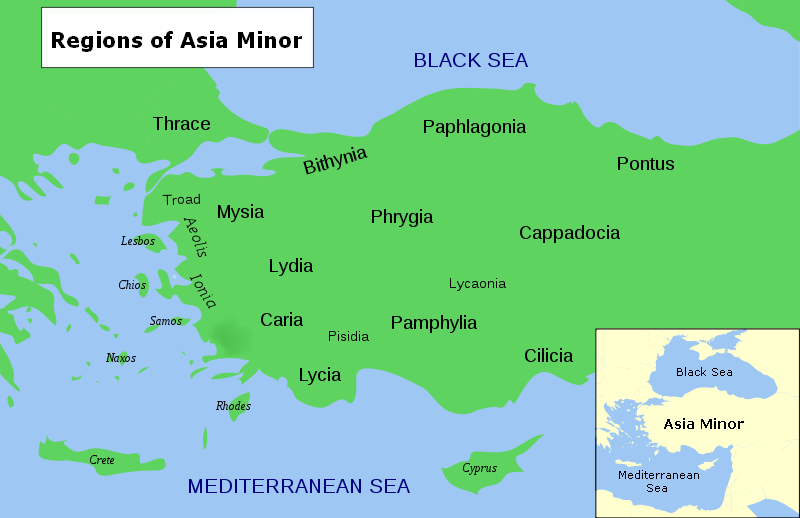
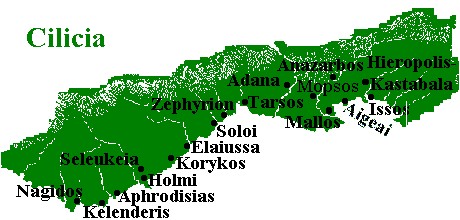
in the south-east of Asia Minor consists of two parts: the inaccessible western
area of the Taurus mountains, also known as "rough Kilikia",
and the eastern plains (modern Çukurova), which are
dominated by the rivers Kydnos, Saros and Pyramis. The Anti-Taurus is the region's northern
border, which contains the Kilikian gate, a pass that connects
the plain with Kappadokia in the north. From times immemorial,
the two areas belong together. In the second half of the the
second millennium BC, the entire region, known as Kizzuwatna,
was part of the Hethitian empire. Contemporary sources mention
the two main cities on the plains: the residence Tarša
(better known as Tarsos) and Adanija (Adana). The most important
language was Luwian. After the fall of the Hethitian empire
(after 1215 BC), the two areas were included in a new kingdom
called Tarhuntassa, which had its capital in Pamphylia. When
the Assyrians discovered the region in the ninth century BC,
they called the fertile eastern area Que (its capital was
Adana), and the western area Hilakku; from this word Kilikia is derived.
In 612
BC, the Babylonians and Medes captured the Assyrian capital
Nineveh. Hilakku survived the collapse of Assyria, and a new
kingdom came into being, in which both areas were united.
The Greeks rendered the title of its kings, suuannassai,
as syennesis, and the name of the country as Kilikia. It is
certain that in 547/546 BC, the Persian king Cyrus the Great
campaigned in the countries west of the Tigris. It must have
been at this stage that he added Kilikia to the Achaemenid
empire, making the syennesis a vassal king. Its capital was
Tarsos, where the loyal syennesis had its residence. It had
to pay tribute: 360 horses and 500 talents of silver, according
to Herodotos. There were several important sanctuaries, and
the oracle at Mallos.
At the
end of the fifth century BC, the third known and probably
last syennesis was ruling Kilikia. He became involved in a
civil war between Artaxerxes II and his brother Cyrus the
Younger. When the latter approached the Kilikian gate, the
syennesis was forced to side with him. However, after the
defeat of Cyrus at Cunaxa near Babylon, the syennesis' position
was difficult and he was dethroned. This marked the end of
the independence of Kilikia. After 400 BC, it became an ordinary
satrapy. One of its satraps was the Babylonian Mazaios (361-336
BC), who was an important Persian official and ruled not only
Kilikia, but beyond (some say even Jerusalem). His successor
was expelled by Alexander the Great, who conquered Kilikia
in the summer of 333 BC, along his tour of Asia Minor. Alexander appointed a new satrap
of Kilikia, Balakros.
After
the death of Alexander III (323 BC), Kilikia was first part
of the kingdom of Antigonos Monophthalmos, who had been appointed
as satrap of Phrygia. When he was defeated at Ipsos (301 BC),
Kilikia was divided by Seleukos and Ptolemy I Soter, two former
friends of Alexander. From now on, the coastal towns belonged
to the Ptolemaic empire, and the interior was part of the
Seleukid empire. Twice, the region was contested: in the Second
Syrian war (260-253 BC), the Ptolemaeans gained ground, but
in the Fifth Syrian war (202-198 BC), all of Kilikia became
Seleukid. It remained so for a century, and was thoroughly
hellenized. New cities were founded, and the old Luwian language
was gradually superseded by Greek. However, after ca. 110
BC, the Seleukid power was waning, and the inhabitants of
"rough Kilikia", which had always retained some
of their independence, started to behave as pirates. Both
the Seleukid and Roman authorities sometimes launched expeditions
against the Kilikian pirates, but were not greatly successful.
It was
only after 80 BC, when it became clear to the Romans that
the Seleukid empire was disintegrating and a power vacuum
was growing, that the legions intervened. In 78-74 BC, Publius
Servilius Vatia subdued western Kilikia. To commemorate his
victory, he received the surname Isauricus. Eastern Kilikia
became part of the empire of the Armenian king Tigranes. However,
the Kilikian pirates remained dangerous, until Pompey the
Great attacked them. He settled them in towns and gave them
land (67 BC). This turned out to be an excellent settlement.
The last Kilikian war was conducted by Marcus Tullius Cicero
(51-50 BC), who defeated the last independent Kilikians.
During
the next decade, the Romans were unable to establish their
power, because they were involved in two civil wars. When
Octavian became sole ruler (after 30 BC), Kilikia was finally
pacified. Parts were given to vassal kings, and the remainder
became an appendix to the province Syria. Although the governor
of Syria sometimes had to fight against the mountain tribes,
Kilikia was now a quiet part of the Roman world. The emperor
Vespasian reunited Kilikia in 72 AD. More than two centuries
later, it was divided into two parts by Diocletian: the mountainous
west became known as Isauria, and the plains retained the
name Kilikia. In the late fourth or early fifth century AD,
the remainder of Kilikia was again divided into two parts,
simply called Kilikia I (Tarsus and environs) and Kilikia
II (the eastern plains). [Based on article
by Jona Lendering - Livius.org]